未分类

Composed of air and light: a rare survival from medieval Egypt

Chapter Author(s): Carolyn Perry


Book Title: Petrie Museum of Egyptian Archaeology

Book Subtitle: Characters and Collections

Book Editor(s): Alice Stevenson

Published by: UCL Press

Stable URL: https://www.jstor.org/stable/j.ctt1g69z2n.40

JSTOR is a not-for-profit service that helps scholars, researchers, and students discover, use, and build upon a wide

range of content in a trusted digital archive. We use information technology and tools to increase productivity and

facilitate new forms of scholarship. For more information about JSTOR, please contact support@jstor.org.

Your use of the JSTOR archive indicates your acceptance of the Terms & Conditions of Use, available at https://about.jstor.org/terms

This content is licensed under a Creative Commons Attribution-NonCommercial-NoDerivatives

4.0 International License (CC BY-NC-ND 4.0). To view a copy of this license, visit
https://creativecommons.org/licenses/by-nc-nd/4.0/.

UCL Press is collaborating with JSTOR to digitize, preserve and extend access to Petrie Museum

of Egyptian Archaeology

Composed of air and light: a rare survival from medieval Egypt

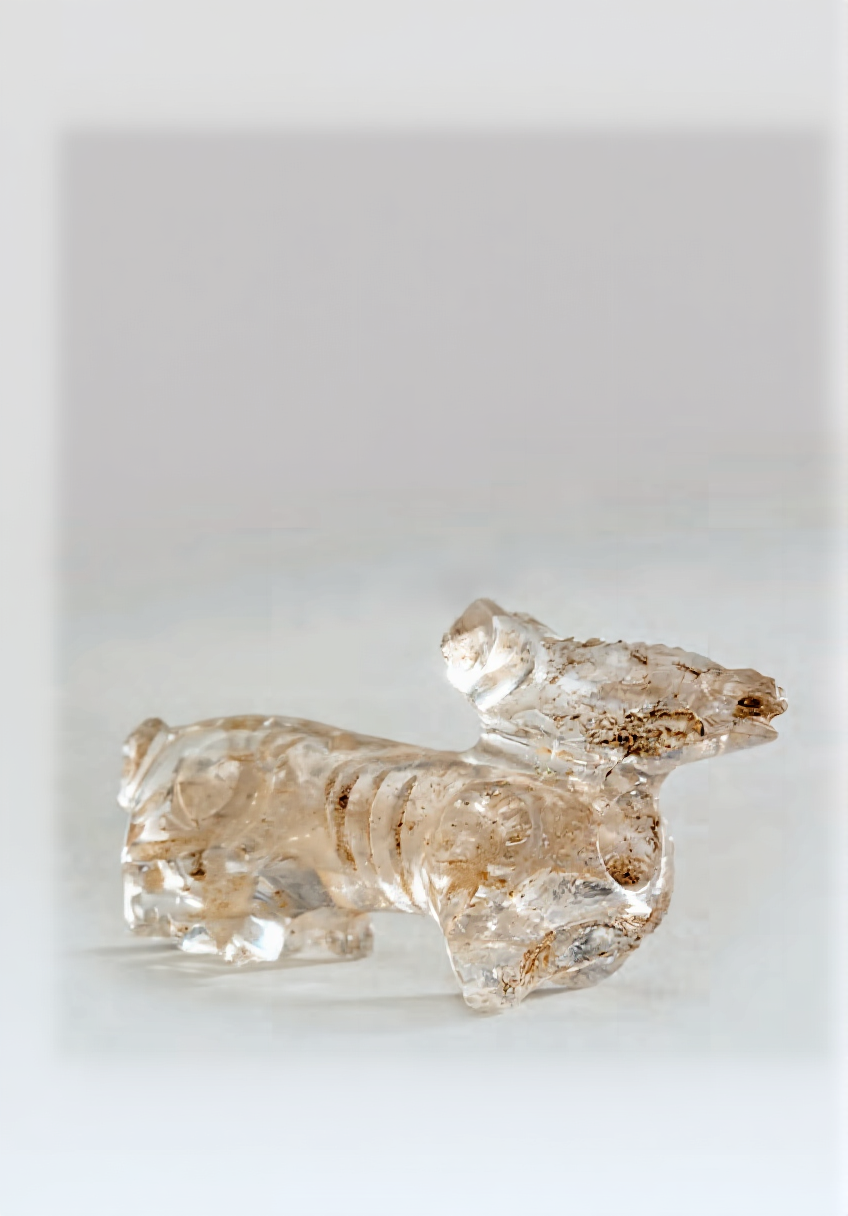
With its sad-looking broken legs, tail and ears, this animal-shaped container seen opposite may look unprepossessing, but it is in fact one of only around 200 rock crystal objects that survive from medieval Egypt. Petrie is thought to have bought this small rock crystal animal in Memphis on 1 March 1908.
Rock crystal, a form of quartz, was particularly highly prized during the rule of the Fatimid dynasty (ad 969–1171). Ahmad al-Maqrizi (d. ad 1442) wrote a History of the Fatimids and tells us that the treasury of the Caliphs included more than 17,000 crystal objects. Al-Maqrizi’s source was probably court offcial Ibn al-Zubayr’s ‘Book of Gifts and Rarities’, which cites 36,000 examples of cut glass and rock crystal. This popularity is partly due to the fact that rock crystal was believed to have magical or prophylactic properties – drinking from a crystal vessel could, for example, cure nightmares or permanently ward off thirst. Postulated by some medieval Islamic scholars to be composed of air and light, rock crystal was connected with the religious beliefs of the Fatimids. In the Qur’an (XXXVII, sura al-saffat, vv. 45–7) it is associated with life in Paradise.
Rock crystal also appealed because it was rare and completely transparent. The raw crystal was imported from various regions, but also found in Egypt in the Western Desert and Sinai. It was diffcult to work (which might explain the rather elongated form of the creature in the Petrie), and only a few centres of production are known. Persian traveller Nasir Khusraw (d. ad 1088) describes a visit to the Suq al Qanadil (Lamp Market) in Cairo, where he saw rock crystal being carved.
So why have so few rock crystal vessels from this period survived? Social disturbances and the bankruptcy of the Fatimid state in the eleventh century led to the pillaging of the court treasury and a dispersal of its famed treasures, including the thousands of rock crystal objects. Some came to Europe in the Middle Ages, often as reliquaries, and can now be found in the treasuries of churches.
The Petrie crystal container has a hole drilled under the chin of the animal and into its body. Several museum collections include small zoomorphic containers, but scholars cannot agree on their purpose. They would not be very effcient as perfume or unguent containers since the horizontal shape might lead to spillage. Some may have contained amulets, a good ft with the prophylactic and magical aspects of the crystal.
But what is the animal now in the Petrie? The most popular creature in Fatimid art is the hare, and in particular the running hare, which is often seen with or surrounded by grapevines. It represented good fortune, and fertility in the sense of the sustainment of life. It is diffcult to be absolutely sure because of the broken ears and legs, but a stylized hare is the most likely identifcation of the Petrie piece, legs up as he runs along, and ears fying behind him in the wind: a small but very signifcant reminder of the vibrant luxury of medieval Egypt.

Carolyn Perry

发表回复

您的邮箱地址不会被公开。 必填项已用 * 标注